Coming up: tickets, itineraries, money-saving tips, some MASSIVE discounts, a few unfair comparisons, famous journeys, our recommended world-class 7-day adventure, and the ultimate rail travel guide to Scotland by train!
🏴 Scotland is one of my favorite places on the planet.
… and train travel might be the world’s most exciting and attractive way to get around 🚂
So in this guide, we’ve helped you combine the two: here’s everything you need to know about traveling around Scotland by train. Choo choo! 🎉
Is train travel good in Scotland?
In general, yes.
🚂 Scottish train travel is faster, cleaner, more organized, and more reliable than most of the world’s train travel. Trains are regular, lines are well-maintained, and trains are modern. In general, if a person from the UK wants to use the most pleasant type of transport they can, they will choose a train 🎉
… and because lots of Scotland is much more remote and rural than most people expect, train journeys are super-scenic. On lots of Scottish train journeys, the views are VERY pretty.
That said, if you’re from other parts of western Europe (like Germany or Austria or Switzerland), or if you’re from Japan, you might be a bit disappointed and underwhelmed with Scottish trains 😞
Although they’re good, UK trains can be a bit unreliable. They’re often late, they’re sometimes canceled, and they’re expensive if you don’t book them in advance. Which brings us to…
How do I book train travel in Scotland?
To book any and all trains, head to Trainline.
🚂 In some countries, train travel is centralized, with all trains being managed and operated by the government (so one provider manages all trains). In the UK, that’s not the case—train travel was privatized back in the 1990s, so there are lots of companies offering different routes across different parts of the UK.
All these companies have their own routes, their own prices, and their own websites.
… and you don’t want to go through the hassle of checking all those different routes and websites. 🙄
So (I’m finally getting to the point I want to make here): when I’m looking for and booking train tickets, I ALWAYS use Trainline, which is basically like Skyscanner, but for trains and train tickets.
🗓️ You plug in the days you want to travel, and you get a priced list of all the potential options and times. Simple. It’s super user-friendly, the site accepts foreign cards, and it (literally, in yellow) highlights the cheapest trains on each day.
When booking your train, you can usually choose the type of seat you want: like seats at a table, seats with a power socket, seats by a window, and so on.
✅ After you’ve booked your ticket, you’ll receive a QR code by email. That QR code is your ticket. You can receive your tickets in other ways (like via mail, or by picking it up from a machine in a train station), but basically no-one uses those options.
How can I save money on train tickets in Scotland? (part 1)
The first and best (and most significant) way is: GET A RAILCARD! 🗂️
While UK trains are expensive, the UK train network offers 9 different types of railcards; so it’s basically almost certain that you’ll find a railcard that applies to you, your age, and your personal circumstances*.
(*for example, you can get railcards for 16-25s, 25-30s, seniors, couples, and loads more).
With most railcards, you get a 33% discount (yep, you read that right!), on each train ticket you buy.
… and most of the railcards cost around £35 per year. So, even if you only travel on Scottish long-distance trains 2 or 3 times, you WILL save money. To put it in simple terms: if you’re gonna be spending over £120 on train tickets in the UK, you’ll save money by buying a railcard! 💸
How can I save money on train tickets in Scotland? (part 2)
💰 As you’ll see on the Trainline website, different ticket prices apply to different times of day… and a great way to save money on train tickets is by booking off-peak train tickets*.
*In the UK, ‘off-peak’ usually means after 09:30 in the morning… but also outside the peak travel hours of 15:30 and 18:15.
So, if you can be flexible, look at the tickets during the off-peak window… and Trainline will show you the cheapest tickets during this window. Good ol’ Trainline! 🥳
You should also book tickets in advance (but not super super far in advance). I’ve usually found that booking around 6-8 weeks before your travel date is the best window for finding the best prices.
🎫 To give you a concrete example: I just looked at train tickets now, for a 2-hour Scottish journey. If I travel tomorrow, during peak time, I would be paying £57. But if I travel in 6 weeks, during off-peak time, I would be paying £15 for the exact same journey. And if I had a railcard, that £15 would become £10.
… and that difference (from £57 to £10!) is massive! 🤑
What are my other travel options in Scotland?
For short distances (around 1 hour or less), Scotland has lots of buses.
🚍 Like Scottish trains, these buses are all managed and operated by different companies; but you can find centralized information on Traveline… and Google Maps is brilliant for finding route information (when traveling on buses in the UK, Google Maps is the ONLY resource I ever use).
If you’re traveling in populated areas, buses are usually pretty regular and reliable.
🌳 … but if you’re traveling in rural areas, there’s a very good chance that the buses will be irregular and unreliable (and there’s even a chance that they won’t exist!).
For long distances (of over 1 hour), Scotland has a VERY GOOD long-distance coach network. These coaches are operated by three different companies: Megabus, National Express, and Flixbus… and there’s no centralized way to check routes (and the routes don’t appear on Google Maps). In my experience Megabus is the most reliable and regular of the three… so wherever you’re going, you can probably just check the Megabus website, if you don’t find what you need you can try the other two.
🗓️ Coaches are MUCH cheaper than trains for long-distance Scottish travel (especially for spontaneous last-minute travel). For example, I could book a coach right now, for a trip from Edinburgh to Inverness later today, for only £19. A train would be AT LEAST 3x as expensive. 💸
… and, often, the travel times aren’t too much longer—Scottish roads are fast, direct, and well-maintained. In addition to that, coach travel is often a bit more reliable. Trains are often late and delayed—but long-distance coaches rarely are.
⛴️ For traveling to islands (and Scotland is home to more than 900 of them!), you’ll also find loads of ferries. To check all ferry timetables (and buy ferry tickets), get yourself over to the CalMac website.
👍 There IS a fourth option for long-distance travel in Scotland: hitchhiking.
I’ve hitchhiked in Scotland 100s of times, and I’ve always felt super safe (and had fun experiences, made lots of friends, and seen places and things that I wouldn’t have otherwise seen).
If you’re a man, I completely recommend it. If you’re a woman, it’s obviously A LOT less safe (because of some of the men you might encounter). I DO have female friends who’ve hitchhiked in Scotland alone, and they’ve told me they felt safe (and were safe); but I of course don’t have lived experience of solo female hitchhiking, so I can’t personally recommend it.
Iconic train journeys in Scotland
Train travel, obviously, is a great way to conveniently get around.
… but it’s also a nice way to see loads of pretty sights and scenes without having to hike or cycle or drive* (which I know is pretty obvious).
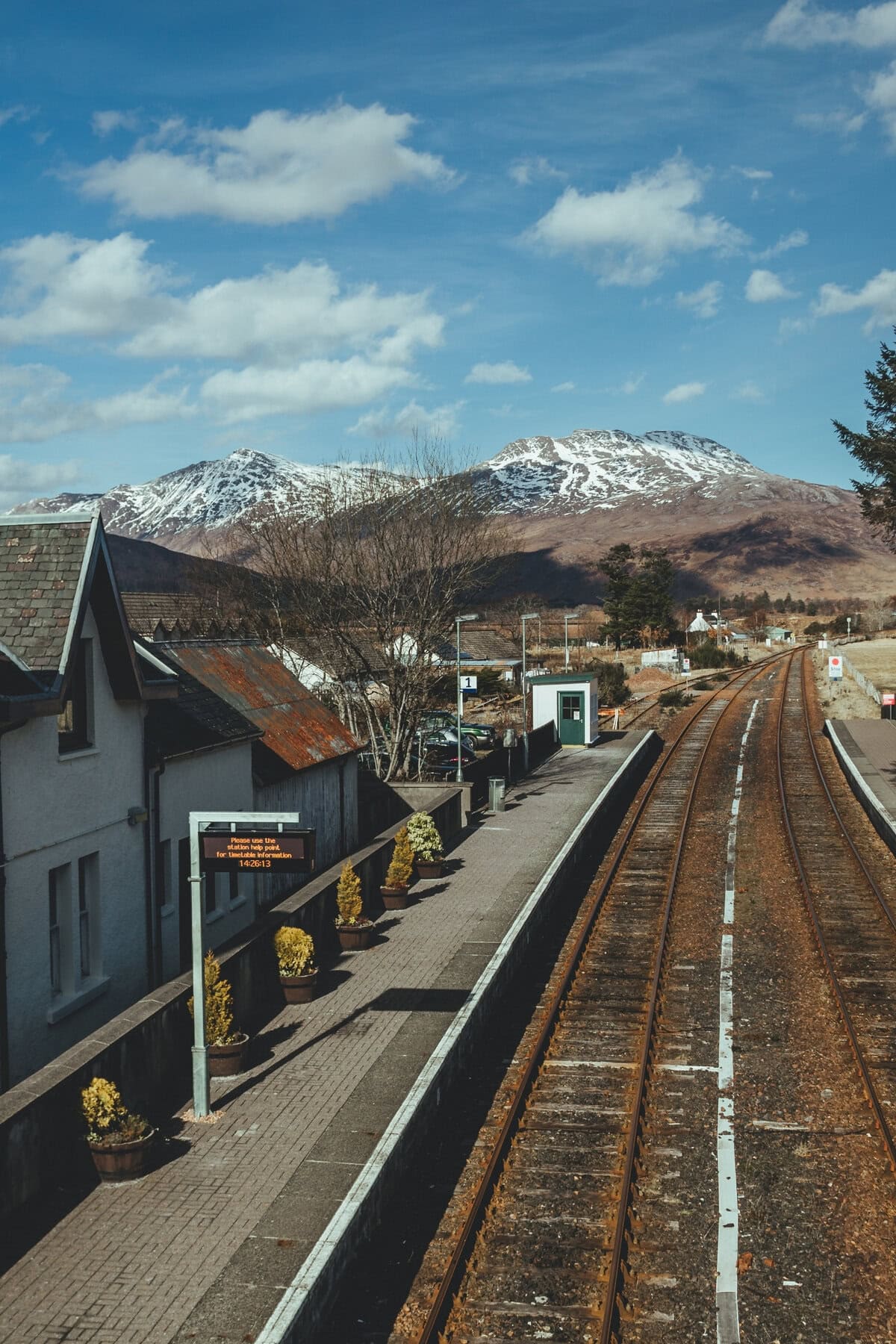
So, in honor of that, here are some of the most beautiful Scottish railway routes:
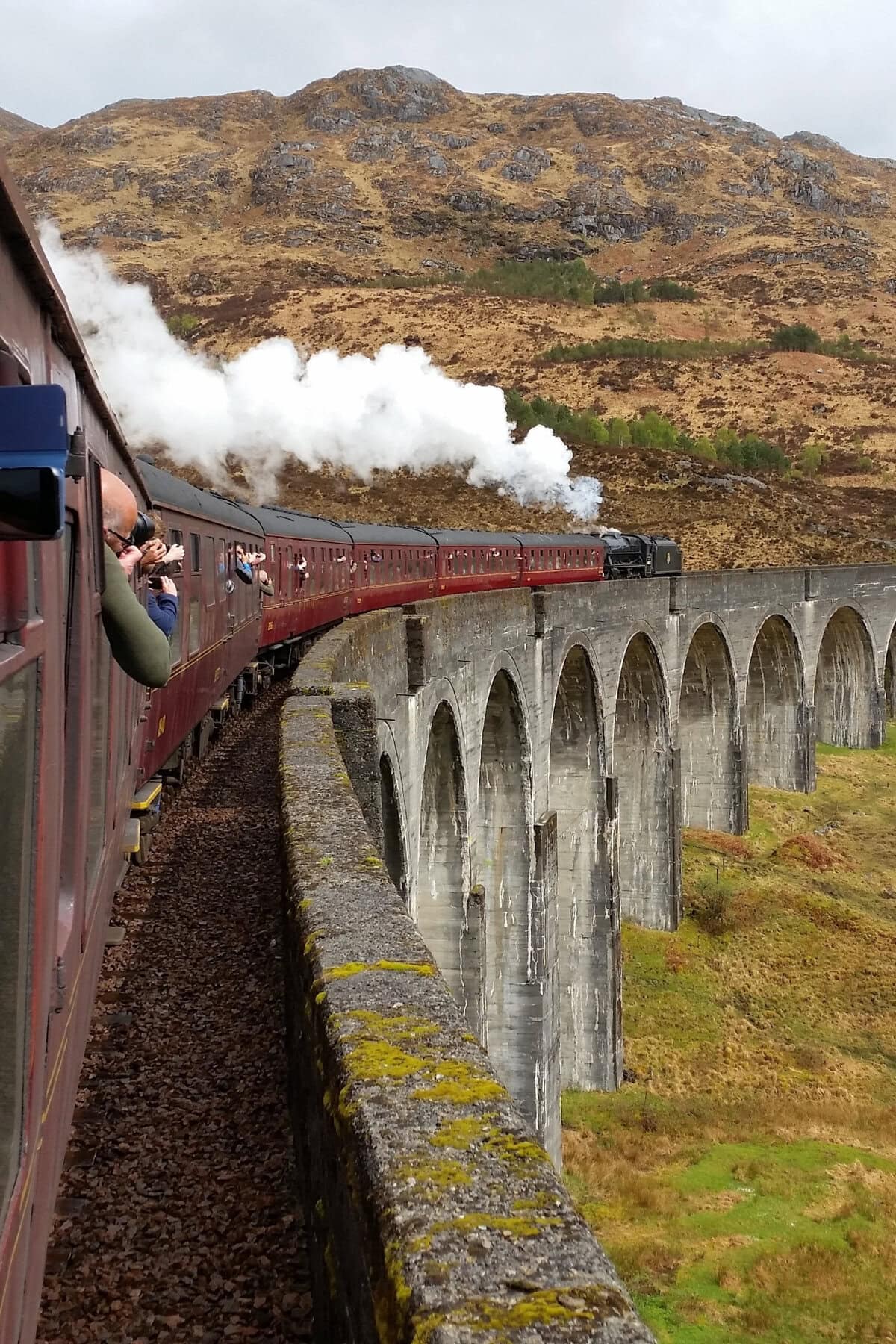
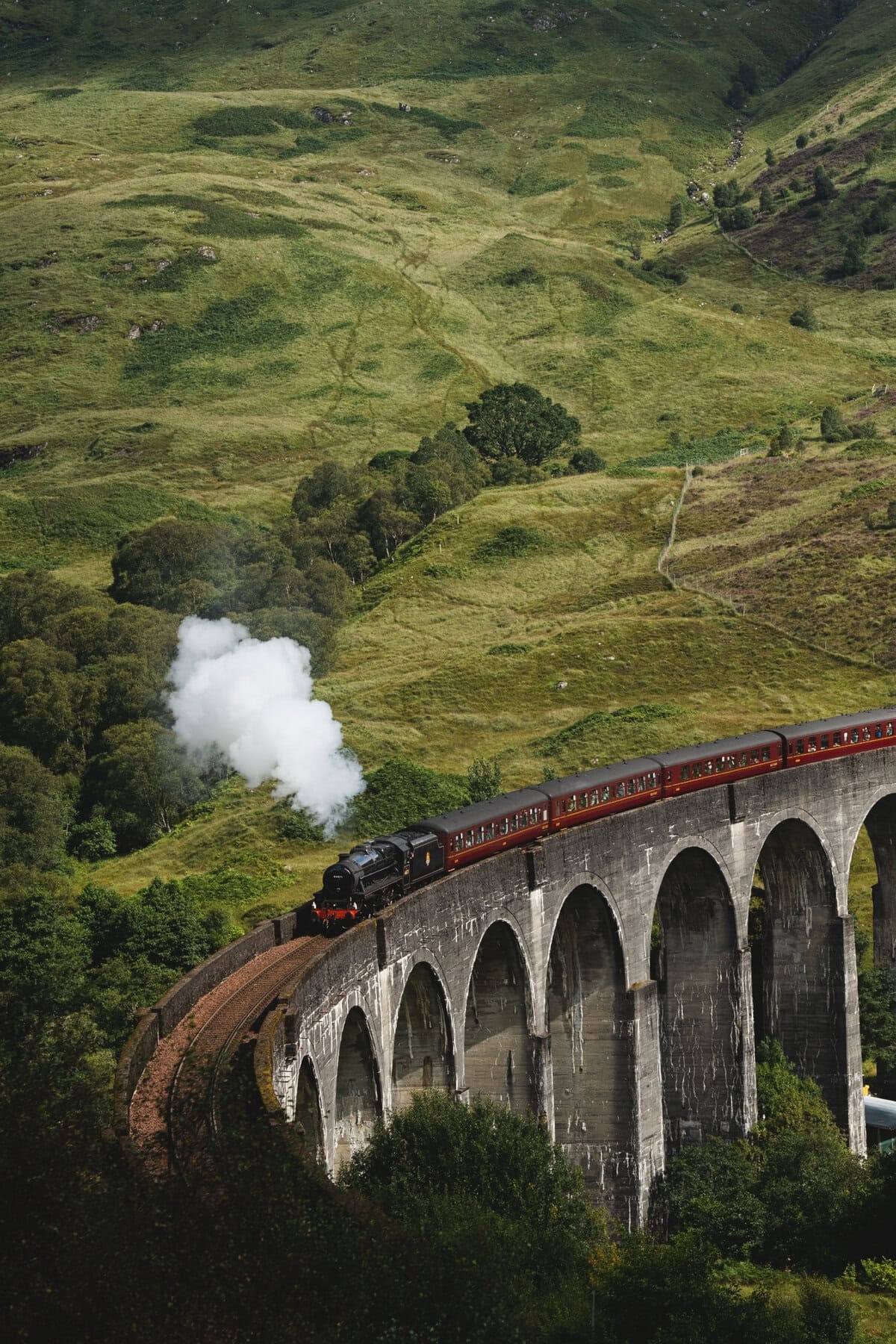
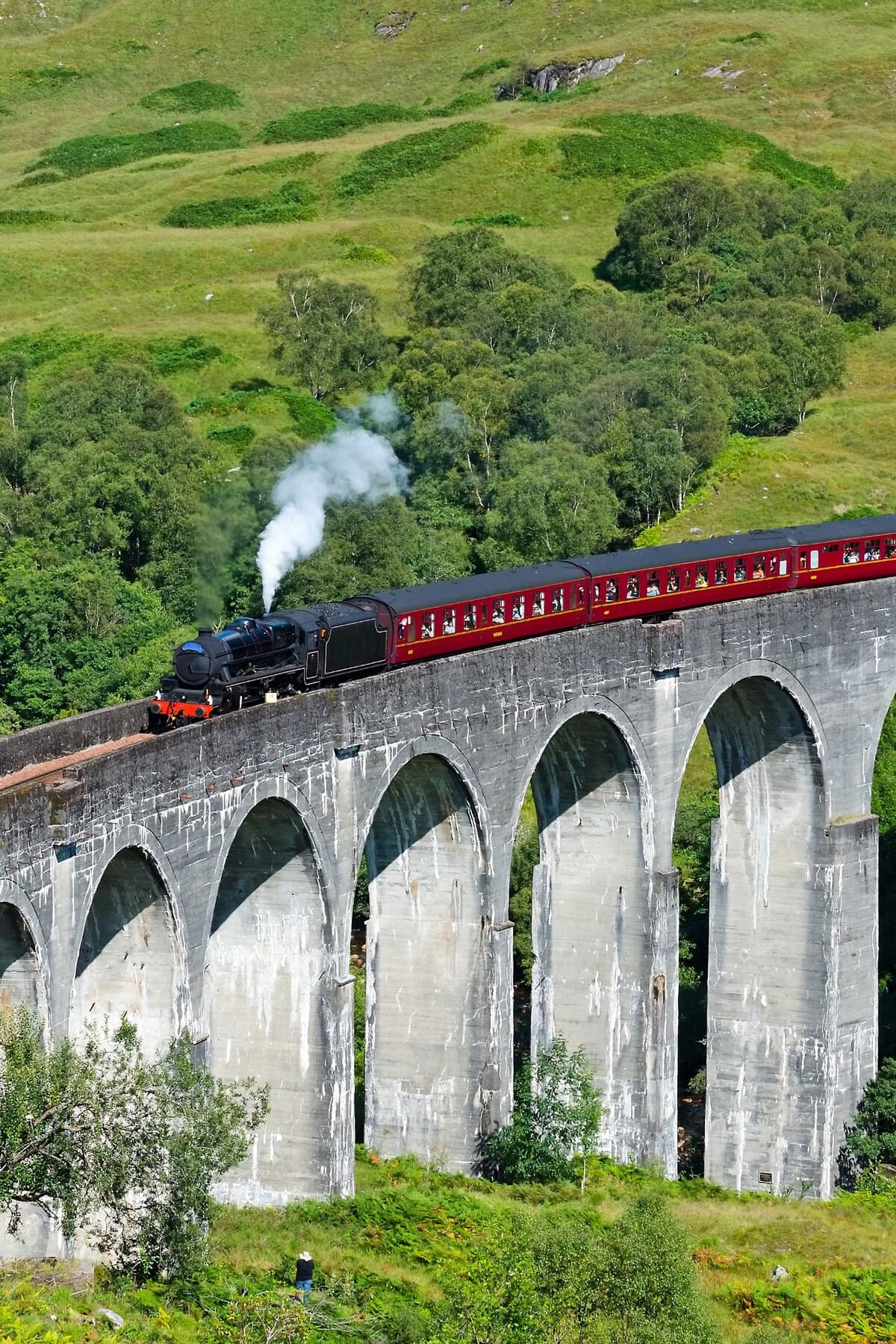
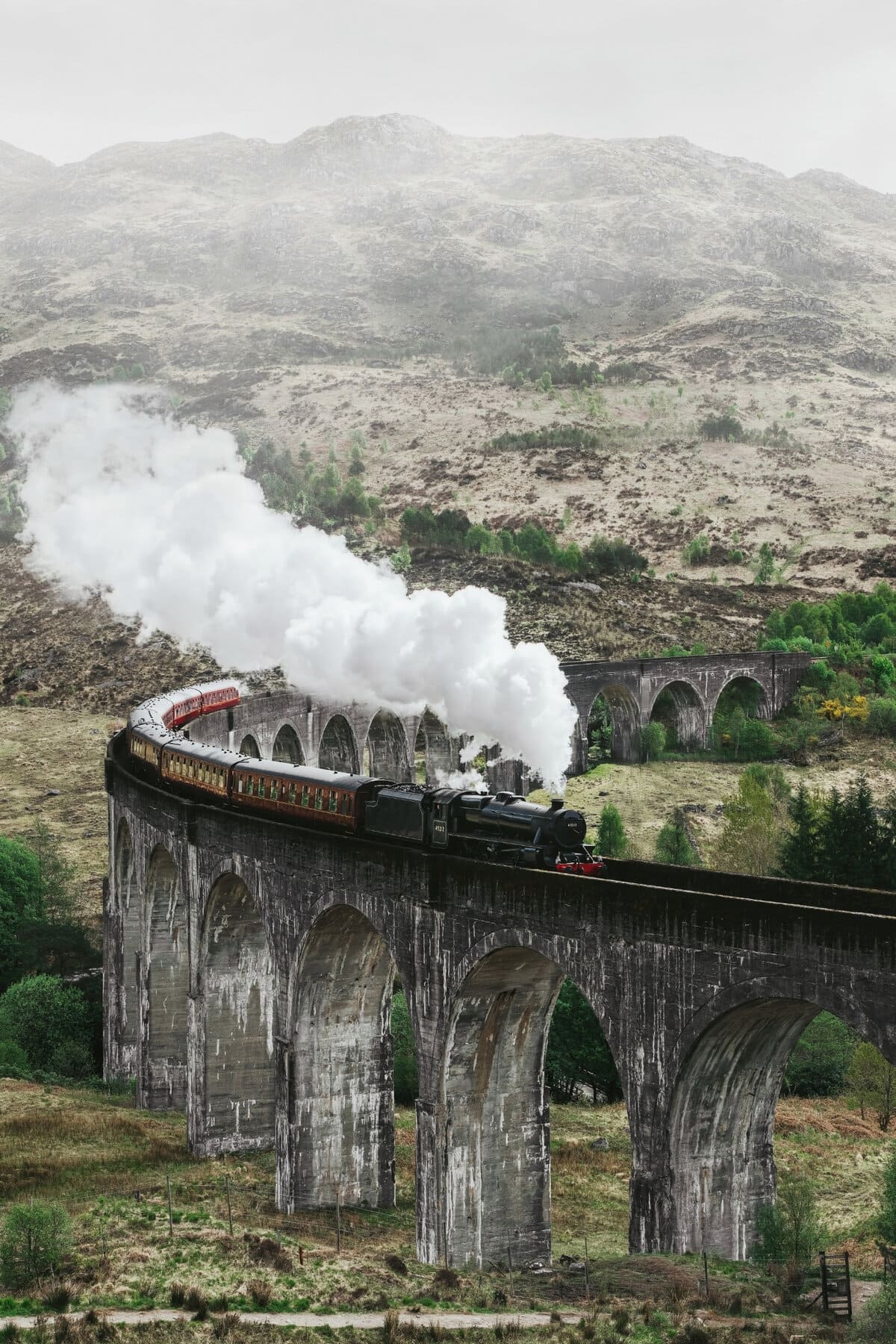
- The West Highland Line: some people reckon this is the most scenic railway ride IN THE WORLD. It runs from Glasgow, and heads north to the valley village of Crianlarich. At Crianlarich, you can then go past Loch Awe to Oban, or go through Rannoch Moor to get to Fort William and Mallaig. In my opinion, the second option is the best one (and when most people talk about the West Highland Line, this is the route they’re actually talking about). On it, you’ll find the Glenfinnan Viaduct (the train bridge you’ve seen in the Harry Potter movies).
- The Kyle of Lochalsh Line: also known as simply ‘The Kyle Railway Line,’ this cuts east to west between Dingwall (close to Inverness), and the waterside Kyle of Lochalsh. Kyle of Lochalsh is the village where you’ll find the mainland bridge to Skye—and the journey features lochs, moors, and distant views of the iconic Torridon peaks.
- The Far North Line: the most northern railway line in the UK, this isn’t necessarily super-scenic, but it heads from Inverness to the remote coastal towns of Thurso and Wick (both of which are pretty close to the iconic John o’ Groats). It’s a great way to watch Scotland go from civilization to super-remote. And, uniquely, the route has seven ‘request stops’—places so remote and quiet that the train will only stop at these stations if the driver receives advance-notice that someone will be boarding there!
- The Highland Main Line: running from Perth to Inverness, this route crosses the UK’s highest railway summit (at 452 meters/1,480 feet), and heads through Cairngorms National Park (the biggest national park in the UK). Expect moors, forests, underrated peaks, and some hyper-pretty Highland towns.
*btw, if you DO want to hike or cycle or drive in Scotland (because the nation is maybe my favorite outdoor-adventure place on the planet), we have LOADS of guides for you. Including:
- The 15 best hikes in Scotland
- The 18 best road trips in Scotland
- The 15 best hikes in and around Glencoe
- The 19 best hikes in and around Edinburgh
- The 13 best cycling routes in all of Scotland
- The 13 best cycling routes in and around Edinburgh
- The 15 most beautiful hikes in and around Glasgow
- Everything you need to know about the North Coast 500 (my favorite-ever road trip)
Practical tips for train travel in Scotland
- UK trains have space for luggage, but not LOADS of space. If you have one big bag (suitcase or backpack), and one smaller bag (again, suitcase or backpack), then you’ll be fine. But any more than that, and you might struggle.
- You’re allowed to eat food on UK trains. You can usually also buy food on long-distance trains, but I never do—it’s flavorless and expensive and unhealthy. Instead, I bring my own food with me. Train stations in cities will always have small food stores in them. Smaller train stations might not—but you’ll always find stores or bakeries close to train stations.
- Toilets on Scottish trains: all UK trains have toilets, and most UK train stations have toilets. In some of the bigger train stations, you might need to pay to use the toilet. In smaller stations, you won’t. The toilets in trains are free to use.
- Long-distance train tickets usually come with a seat reservation. On your ticket, you’ll see which seat you have been assigned. You should sit on that seat, cos British people are pretty strict about those types of rules.
- UK trains usually have WiFi, but the WiFi is usually pretty bad—so I wouldn’t rely on it. Most long-distance trains have charging points in the seats. But, again, this isn’t necessarily always the case. It’s best to also have a data connection (although data is also unreliable in the most remote parts of Scotland, lol). To get an eSIM, use AirAlo; they’re the best eSIM provider I’ve ever found, by a very long way.
Mistakes to avoid while traveling on trains in Scotland
We’ve already mentioned some of these, but cos lots of Scottish newbies find themselves making these mistakes, they’re worth briefly repeating:
- Again, if you book a train too late, you might pay 3-4x more than if you’d booked it in advance. Try to book your tickets around 6-8 weeks before you plan to travel.
- Don’t underestimate travel times: if you’re used to traveling on German or Swiss or Japanese trains, you’ll probably think Scottish trains are slow. So always check the estimated travel time (and compare it to any other transport options) before you book. This is especially true if your journey isn’t direct, and you need to change trains during your journey. For example, to travel from Inverness to Glasgow today, some of the journey options take 4 hours. Not super-lengthy, but also not as fast as you might have assumed.
- British trains are also more unreliable than you think. Visitors assume that the UK has German-like efficiency. But while that’s not totally removed from the truth, it’s also not completely true.
Our suggested itinerary for one week of train travel in Scotland
To plan your own route(s), here’s an excellent official overview map of Scotland’s rail network.
… but if you want our advice (and if you want to to see LOTS of Scotland while exclusively traveling on trains), here it is:
- Day 1, Newcastle* to Edinburgh: leftfield, I know, because I’m making you start your journey in England. But the ride from Newcastle to Edinburgh runs along the Berwickshire coast, it’s underrated and beautiful, and it takes you over the Scotland-England border. In my opinion, it’s the best possible way to enter Scotland.
- Day 2, Edinburgh** to Glasgow***: running between Scotland’s two major cities (its capital and its biggest city), the ride from Edinburgh to Glasgow only takes an hour, and it’s not particularly pretty… but both cities are must-visits. And from Glasgow, the super-scenic train fun really begins…!.
- Day 3, Glasgow to Fort William: this is the first part of the West Highland Line. For the best views, sit on the left-hand side of the train: you’ll see the shores of Loch Lomond, the village of Tyndrum (the UK’s smallest place to have two separate railway stations!), the remote Rannoch Moor (where the line is lifted above the ground to escape the boggy terrain), the UK’s loftiest train station (at Corrour), and plenty more views and vistas.
- Day 4, Fort William to Mallaig: this is the second part of the West Highland Line—and most people agree it’s the best part. Most famously, this section runs over the Glenfinnan Viaduct—the same route that Harry Potter rides over on his way into Hogwarts. You also get lochs, moors, mountain views, and what might be the most remote church you’ve ever seen.
- Day 5, Mallaig to Inverness: today, you make your own way from Mallaig to Kyle of Lochalsh (your best option is ferry then bus, via the Isle of Skye), before then riding a train from Kyle of Lochalsh to Inverness. So—you’ll be riding on the Kyle of Lochalsh Line (or the ‘Kyle Railway Line’) which we mentioned earlier.
- Day 6, Inverness to Aberdeen: running through Speyside, this route isn’t massively scenic, but it’s a great way to start heading back south. Expect rolling hills, distant castles, and loads of farms and sheep. The left side of the train serves up slightly better views.
- Day 7, Aberdeen to Edinburgh: this ride takes you back to Edinburgh, closing off your loop. Take the LNER service if you can, cos that route runs closer to the coast. Today, you get lots of seaside views, two estuary crossings, the option of getting off the train and exploring Dundee, and the gradual re-entry into busy civilization (via both big and small towns).
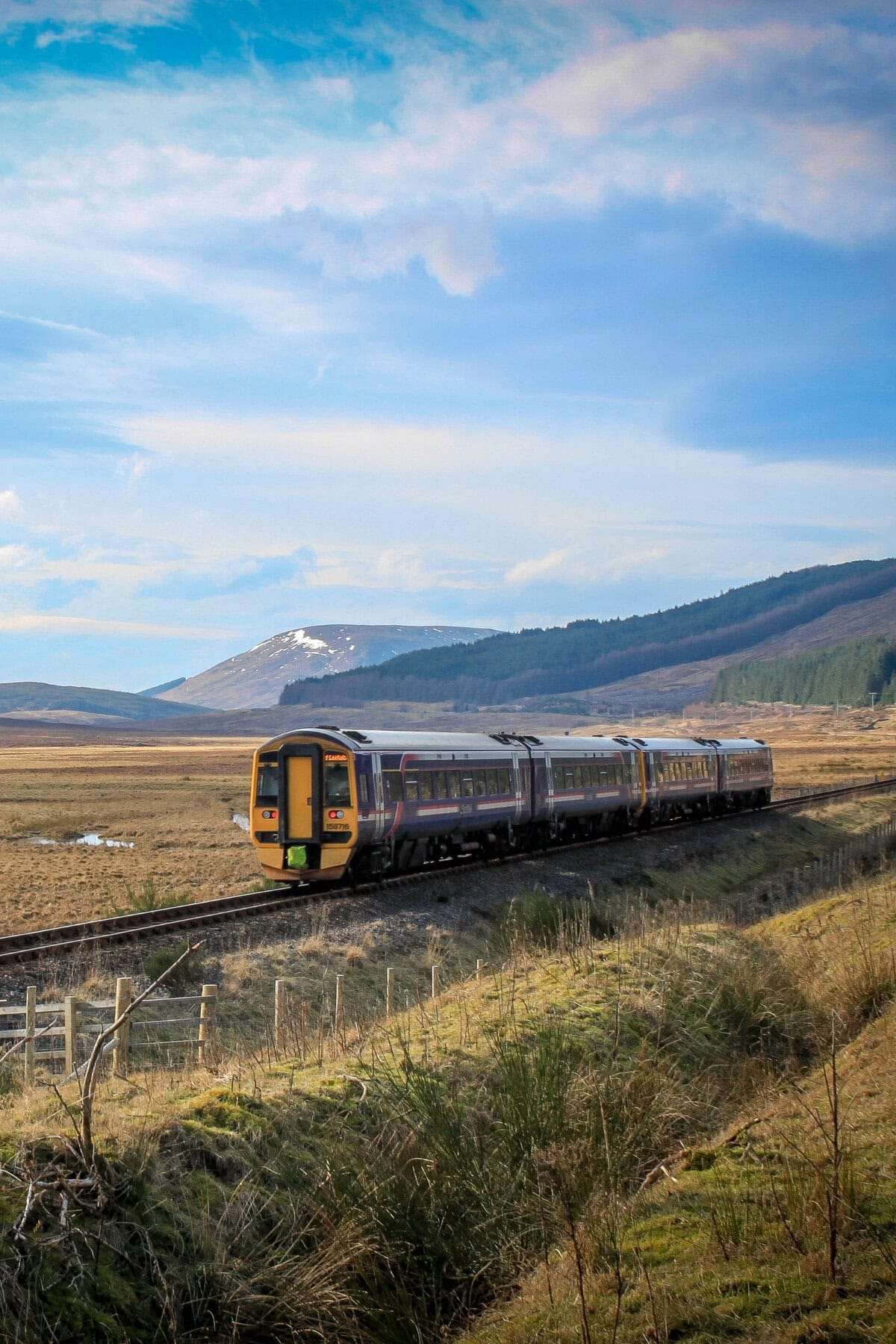
⌚ To be honest, we’ve really rushed days 6 and 7 here, and you could spend A LOT more time traveling between Inverness and Edinburgh—hitting coastal towns like Stonehaven, Montrose, and Kinghorn. But, you can’t do everything! 🤷
*For much more on Newcastle (where I’m from), here are:
- 13 surprising reasons why you need to visit Newcastle
- The 13 best day trips from Newcastle
- The 11 best tours in Newcastle
**For much more on Edinburgh, here are:
- The best time to visit Edinburgh
- The best places to stay in Edinburgh
- The 18 best tours in (and from) Edinburgh
- Our ultimate itinerary for 2 days in Edinburgh
***For much more on Glasgow, here are:
- The best areas and hotels in Glasgow
- The 11 best road trips from Glasgow
- The 15 best day trips from Glasgow
Before You Go
🚂 So, there you have it; everything you need to know about traveling through Scotland by train!
To sum up, our top three tips are:
- Book your train tickets around 6-8 weeks before you plan to travel. That’s the sweet spot for finding the best prices. And make sure you use the Trainline to book your tickets; it’ll save you time and money.
- Although train travel is a GREAT way to see Scotland (and although some of the scenes and sights are beautiful), it’s certainly not the ONLY way to tackle long-distance travel in the nation. Coach travel is much cheaper, and often equally fast and almost as comfortable.
- If you’re traveling by train specifically to see Scottish scenery, our top three picks are The West Highland Line, The Kyle of Lochalsh Line, and The Highland Main Line.
🏴 For more Scottish adventures, head over to our guides on:
- 20+ strange Scottish places you didn’t know about
- 25 secret off-the-beaten-path hidden gems in Scotland
- Everything you need to know about the shortest flight in the world
Thanks for reading, thanks for choosing Travelness, and we’ll see you again soon. Enjoy exploring Scotland and keep scrolling down! 👋